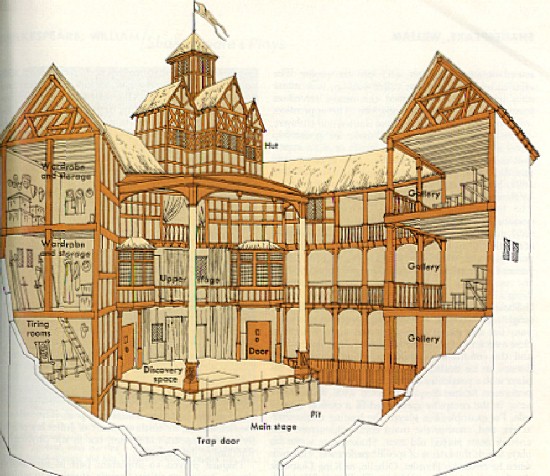
The Globe Theater was constructed in 1599, out of timber taken from the Theater. It stood next to the Rose, on the south side of the Thames, and was the most elaborate and attractive theater yet built. The Globe was designed and constructed for the Chamberlain's Men. Much of Shakespeare's wealth came from his holdings in the Globe.
The
Globe was the primary home of Shakespeare's acting company beginning in late
1599, and it is a possibility that As You Like It was written especially
for the occasion. On June 29, 1613, during a performance of Henry VIII,
a misfired canon ball set the Globe's thatched roof on fire and the whole theater was consumed. Swift reconstruction did take place and the Globe
reopened to the public within a year, with the addition of a tiled roof. The
new Globe theatre lasted until 1644, at which time it was demolished, and
housing was quickly built where it once stood. Recent attempts have been made
to re-create the Globe, and replicas have been built in Tokyo and in London.
The exterior appearance of the Globe can only be pieced together from sketches
of the theater found in sweeping Elizabethan city scenes, and the interior
appearance from the drawing of the Swan Theater. From these images we can
describe the Globe as a hexagonal structure with an inner court about 55 feet
across. It was three-stories high and had no roof. The open courtyard and three
semicircular galleries could together hold more than 1,500 people.
The stage had two primary parts: 1) The outer stage, which was a rectangular
platform projecting into the courtyard, from the back wall. Above it was a
thatched roof and hangings but no front or side curtains. 2) The inner stage
was the recess between two projecting wings at the very back of the outer
stage. This stage was used by actors who were in a scene but not directly
involved in the immediate action of the play, and it was also used when a scene
took place in an inner room.
Underneath the floors of the outer and inner stages was a large cellar called
"hell", allowing for the dramatic appearance of ghosts. This cellar
was probably as big as the two stages combined above it, and it was accessed by
two or more trap-doors on the outer stage and one trap door (nicknamed
"the grave trap") on the inner stage. Actors in "hell"
would be encompassed by darkness, with the only light coming from tiny holes in
the floor or from the tiring-house stairway at the very back of the cellar.
Rising from behind the stages was the tiring-house, the three story section of
the playhouse that contained the dressing rooms, the prop room, the musician's
gallery, and connecting passageways. The tiring-house was enclosed in curtains
at all times so the less dramatic elements of play production would be hidden
from the audience. Two doors on either side of the tiring-house allowed the
actors entrance onto the stage. Sometimes an actor would come through the "middle
door", which really referred to the main floor curtains of the
tiring-house that led directly onto center stage.